Thursday, April 5, 2012
A Vital D&DoLogical Question
Sunday, March 25, 2012
Comic Book Villains Ripe For D&Dification
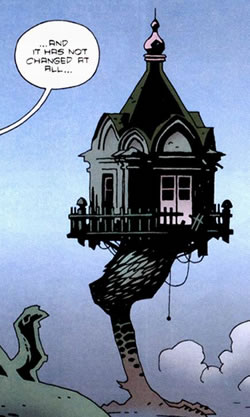
The Time Trapper.
Who is the Time Trapper? Click to enlarge...
"It is known that the Time Trapper dominates the wasteland of Earth in its dying millennia....He possesses great armies and weapons of power, the source of which are unknown"And he looks like that. So you don't even need to change his costume.
Just don't remind him how things used to go back in the day.

Dr Fate When He's Bad
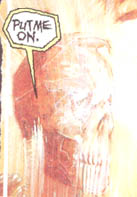
Dr Fate is what DC comics has instead of Dr Strange. He gets his powers from an ancient Egyptian helmet so naturally there are lots of stories where someone bad gets the helmet.
In a Neil Gaiman future story the Fate helmet becomes all corrupt and old and vampiric and suchlike. It sits in a neoEgyptian temple being all...Shuma Gorath
Maybe Shuma-Gorath is cheating--the name is from RE Howard and the rest is pure Lovecraft, but there's something about the platonic tentacle-eyeball-nothing-else simplicity of old S-G that's terribly appealing. And why not give Gorath the same schtick as...Starro The Conqueror
Now, of all the possible individuals who might try to take over the world by having small duplicates of themselves climb onto everyone's face, Starro is maybe less my first choice than, say, Scarlet Johannsen, still, Starro is pretty cool.
So cool I had a Starro attack the PCs at sea a couple weeks ago...Marvel's Merlyn
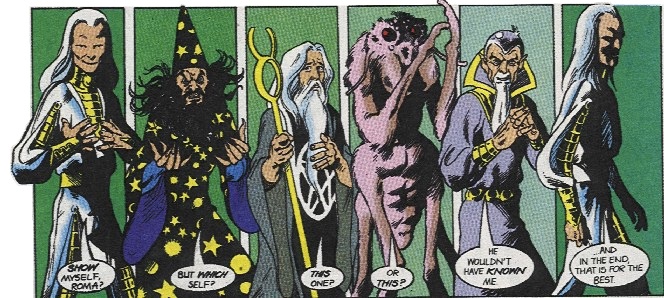
In the case of Alan Moore's take on a manipulative, time-travelling, dimension-hopping Merlyn, a picture is worth a thousand words...
The Mindless Ones
Malekith The Accursed
Not not the blue guy who goes "Oh my stars and garters"--the creature from the Elektra: Assassin miniseries that's worshipped by ninjas and possesses people via evil milk. Also possessed of a fairly impressive traditional claw claw bite routine.
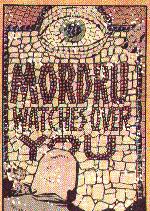
There isn't that much that's special about Mordru per se--he's just another in a long line of beardy wizards--but that issue of Legion of Superheroes (the "Mordru-verse" issue) where he establishes complete Orwellian dominion over Earth using technomagical surveillance and controls all the other villains is pretty sweet.Earth X Uatu
Klarion the Witch Boy
Etrigan The Demon + The Gargoyle
Tuesday, February 21, 2012
The Difficult Adventure
by Charles Bernstein*
originally published in Harper's Magazine June 2003, Volume 306, Issue 1837; ISSN:0017-789x
All of us from time to time encounter a difficult adventure. Sometimes it is the adventure of a friend or a family member, and sometimes it is an adventure we have written ourselves. The difficult adventure has created distress for both GMs and players for many years. Experts who study difficult adventures often trace the modem prevalence of this problem to the early years of the last century, when a great deal of social dislocation precipitated the outbreak of 1978, one of the best-known epidemics of difficult adventures.
But while these experts have offered detailed historical discussions of difficult adventures, and while there is a great deal of philosophical speculation and psychological theory about difficult adventures, there are few practical guides for handling difficult adventures. What I want to do in this essay is explore some ways to make your experience with the difficult adventure more rewarding by exploring some strategies for coping with these adventures.
You may be asking yourself, how did I get interested in this topic? Let me be frank about my situation. I am the author of, and a frequent player of, difficult adventures. Because of this, I have the strong desire to help other players and GMs with hard-to-play adventures. By sharing my experience of more than thirty years of working with difficult adventures, I think I can save you both time and heartache. I may even be able to convince you that some of the most difficult adventures you encounter can provide very enriching aesthetic experiences-if you understand how to approach them.
But first we must address the question-Are you playing a difficult adventure? How can you tell? Here is a handy checklist of five key questions that can help you to answer this question:
1. Do you find the adventure hard to survive?
2. Do you find the adventure's purpose or goal hard to understand?
3. Are there unexpected logistical, moral, or philosophical dilemmas brought up by the adventure?
4. Does the adventure make you feel inadequate or stupid as a player?
5. Is your imagination being affected by the adventure?
If you answered any of these questions in the affirmative, you are probably dealing with a difficult adventure. But if you are still unsure, look for the presence of any of these symptoms: high mortality, tactical, or intellectual activity level; elevated mood intensity; rules irregularities; initial withdrawal (adventure not immediately comprehensible); poor adaptability (adventure unsuitable for use at childrens' birthday parties, pick-up games with random hipsters, etc.); sensory overload; or negative mood.
Many players when they first encounter a difficult adventure say to themselves, "Why me?" The first reaction they often have is to think that this is an unusual problem that other players have not faced. So the first step in dealing with the difficult adventure is to recognize that this is a common problem that many other players confront on a daily basis. You are not alone!
The second reaction of many difficult-adventure players is self-blame. They ask themselves, "What am I doing to cause this adventure to be so difficult?" So the second step in dealing with the difficult adventure is to recognize that you are not responsible for the difficulty and that there are effective methods for responding to it without getting frustrated or angry.
The writers of difficult adventures face the same troubling questions as players, but for them the questions can be even more agitating. Often a GM will ask himself, if he is a man, or herself, if a woman (transgendered individuals also find themselves asking these questions): "Why did my adventure turn out like this? Why isn't it completely accessible like the adventures in the back of rulebooks, which never pose any problems for understanding?" Like players of difficult adventures, these writers of difficult adventures must first come to terms with the fact that theirs is a common problem, shared by many other GMs. And they must come to terms with the fact that it is not their fault that their adventures are harder to understand than the ones in the back of rulebooks, but that some adventures just turn out that way.
Difficult adventures are normal. They are not incoherent, meaningless, or hostile. Well meaning players may have suggested that "something must be wrong" with the adventure. So let's get a new perspective. "Difficult" is very different from abnormal. In today's climate, with an increasing number of adventures being labeled "difficult," this is an important distinction to keep in mind.
Difficult adventures are like this because of their innate makeup. And that makeup is their constructed style. They are not like this because of something you as players have done to them. It's not your fault.
Difficult adventures are hard to play. Of course you already know this, but if you keep it in mind, then you are able to regain your authority as a player. Don't let the adventure intimidate you! Often the difficult adventure will provoke you, but this may be its way of getting your attention. Sometimes, if you give your full attention to the adventure, the provocative behavior will stop.
Difficult adventures are not popular. This is something that any player or writer of difficult adventures must face squarely. There are no three ways about it. But just because an adventure is not popular doesn't mean it has no value! Unpopular adventures can still have meaningful readings and, after all, may not always be unpopular. Even if the adventure never becomes popular, it can still be special to you, the player. Maybe the adventure's unpopularity will even bring you and the difficult adventure closer. After all, your own ability to have an intimate relation with the adventure is not affected by the adventure's popularity.
Once you have gotten beyond the blame game-blaming yourself as a player for the difficulty or blaming the adventure-you can start to focus on the relationship. The difficulty you are having with the adventure may suggest that there is a problem not with you the player or with the adventure but with the relation between you and the adventure. Working through the issues that arise as part of this relation can be a valuable learning experience. Smoothing over difficulties is not the solution! Learning to cope with a difficult session of an adventure will often be more fulfilling than sweeping difficulties under the carpet, only to have the accumulated dust plume up in your face when you finally get around to cleaning the floor.
Players of difficult adventures also need to beware of the tendency to idealize the accessible adventure. Keep in mind that an adventure may be easy because it is not going anywhere. And while this may make for undisturbed playing at first, it may mask problems that will turn up later. No adventure is ever really difficulty-free. Sometimes working out your difficulties with the adventure is the best thing for a long-term aesthetic experience and opens up the possibilities for many future encounters with the adventure.
I hope that this approach to the difficult adventure will alleviate the frustration so many players feel when challenged by this type of aesthetic experience. Reading adventures, like other life experiences, is not always as simple as it may seem to be from the outside, as when we see other players flipping happily through collections of retired 20th level PCs. Very often this picture of playerly bliss is not the whole story; even these now-smiling players may have gone through difficult experiences with adventures when they first encountered them. As my mother would often say, you can't make bacon and eggs without slaughtering a pig.
_________
*I have made the following substitutions:
The word "poem" in the original essay has been turned into "adventure"
"Read" has been turned into "play"
"author" and "poet" into "GM"
"1912" into "1978"
Identifiers 1, 2, 3 and the paragraph after the list have been substantially altered.
"of billy collins" has been replaced with "in the back of rulebooks"
"saying anything" has become "going anywhere"
"best loved verse" has been replaced with "retired 20th level PCs"
The unaltered version is here.
Monday, February 20, 2012
Because Fuck You, That's Why.
Myxomatosis is an animal's disease,
-T. Rex ("Left Hand Luke And The Beggar Boys")
What we end up with are dinosaur-riding sorcerous cavemen exploring ancient ruins and pursuing the Greys for their nifty rocket launchers while being pursued in turn by Nyarlathotep and some undead mummies.
Why? Fuck you, that's why.
-Jim Stutz (RPGnet review of Carcosa)
People talk about and think about this idea:
Mere color, unspoiled by meaning, and unallied with definite form, can speak to the soul in a thousand different ways.
-Oscar Wilde
Pleasure in the potentials of invention is its own and sufficient reward, as this or any wrinkly-cyclops-car-driving baby could easily explain.And now for something that makes no sense and is rad:
bing.
Saturday, February 4, 2012
Please Read These You Will Become Smarter
Wednesday, January 18, 2012
GM Questionnaire
Wednesday, January 11, 2012
Ooh ooh ooh My Turn!

This here proof-of-concept is one of the pictures I did for my all-female cyborg space pirate version of Blood Meridian (that's the Judge on the right with the cigar). If it were up to me, there would be no pictures of men in anything ever, but more than half the population likes men so maybe put one or two hot, mute, deaf, blind, hebephrenic guys in there too. I guess. Worked for Michael Moorcock.
Friday, January 6, 2012
Appendix S
Friday, December 30, 2011
The Best D&D-able Comic Books According To Me

Slaine
Simon Bisley is to Warhammer what Frank Frazetta is to D&D. Or Warhammer is to D&D as Simon Bisley is to Frank Frazetta. Anyway, when he wasn't drawing insane Doom Patrol covers that bend all minds, Bisley did this totally metal barbarian comic and you should buy it.


Ironwolf
I was surprised to hear Keith Baker hadn't seen this steampunk-before-steampunk tale of sabres, swashbuckling, wooden starships, vampires, werewolves, aristocrats, honor, snottiness, cynicism and intrigue before inventing Eberron. When I showed him his eyes just about rolled back in his head.
Howard Chaykin's self-pencilled 70s original is mainly remarkable for the make-Barbarella-weep astrofabulousness of the female character designs and the later, Mike Mignola pencilled Ironwolf: Fires of the Revolution is remarkable because fuck yeah Mike Mignola.
Hellboy
Speaking of Mike Mignola. If you are interested in Hellboy but have never checked out the comics and don't know where to start, I'd start off with The Chained Coffin and Others then, if you're hooked, buy all the others with Mignola art and read them in order. If you're still hooked, the Ryan Sook and Duncan Fegredo ones are an acceptable methadone, though the fact that both artists are both so good when they aren't being hired to draw just like Mike Mignola makes their work there somehow coverbandish in a slightly depressing way.
Some notes here: Mignola's Fafhrd & Grey Mouser adaptation sounds like it can't lose, but the lack of true Leiber prose plus Mignola's inability to overcome the perennial challenge of doing medieval scenes using the traditional comic book coloring process makes this about 25% less sweet than it should be. For things in the same fantastic vein that work out a little better, see the Lovecrafty "Sanctum" story in Batman: Legends of the Dark Knight and Doctor Strange/Doctor Doom: Triumph and Torment.
Blood: A Tale
Kent Williams paints some excellent stream-of-consciousness gobbledegook vampire stuff with swords and snakes and trees and dreams and more unerotic nudty than I have ever seen outside a wrestling ring. 4-issues, easily acquired in one bit.
Elektra Lives Again
Why is this Frank Miller drawn/ Lynn Varley painted modern ninja book listed here?
1-It is criminally under-appreciated and with Frank Miller's reputation sinking every time he opens his mouth, its star will probably only dip lower in years to come, and
2-It has the best medieval-weapon slugfest scene ever in a comic book.

Cerebus
Oh, Cerebus... For those who don't know, Cerebus is 300 black-and-white issues of an Aardvark acting like Conan and a comic book creator going from making fun of Conan to being sublimely inspired to succumbing to a particularly uncharming, pleonastic, and misogynistic brand of insanity. Dave Sim gets very good at drawing shadows and aardvarks, though his people are a little rubbery (though these days a lot of people like that kind of thing, so whatever).
The rundown for the unitiated:
The cheapest preview is a single issue called Cerebus #0. If you like it, buy more:
First book: Cerebus: the "funny-animal" original stories--they read like unusually ambitious Dragonmirth strips but are maybe essential to understanding the more serious stuff that follows.
High society--the first intimations of awesomeness.
Church and State and Jakas Story--What the legend is built on. This is the goods right here. Wintry weird politics, slapstick, isolation, and eccentric worldbuilding.
Melmoth--expendable divagation into an Oscar Wilde obsession.
Flight, Women, Reads, Minds--Good, interesting, maybe great, but the rot is clearly approaching and the misogyny first appears I think in Reads. (Cerebus is rather like the Star Wars question: everyone agrees Empire is the best and that at some point the franchise became terrible--nobody agrees about what point that is.)
Guys--Not as terrible as it is about to get, but clearly now just an old hippie telling jokes about bars.
From then on: total mind rot in progress. Very sad.

Moebius
For English readers, the best starting place is the Epic/Graphitti collected edition #2--Arzach and Other Fantasy Stories. If you like that trip into his frenchy, pterodactyl-laden greenskinned dreamland then you''ll probably like the sci-fi stories in volume 3 Airtight Garage and volume 4 Long Tomorrow. His style has wandered quite a bit over the course of his career: dreamy greens, lumpy cowboys, unhatched New Age-isms, spirally psychedelic erotica, bog-standard balloon-nose French slapstick, so preview anything before spending too much money on it. This might help.
Little Nemo
The earlier full-color strips are a jaw-dropping mix of Ringling-Bros fire-engine-colored Americana, opiated surrealism and art nouveau elegance. There is so much to admire that ignoring the black character in Sambo-makeup and pointlessly meandering plotlines is pretty easy. Last I knew, a complete edition hidden behind an incredibly ugly and unrepresentative maroon-colored hardcover was still available.
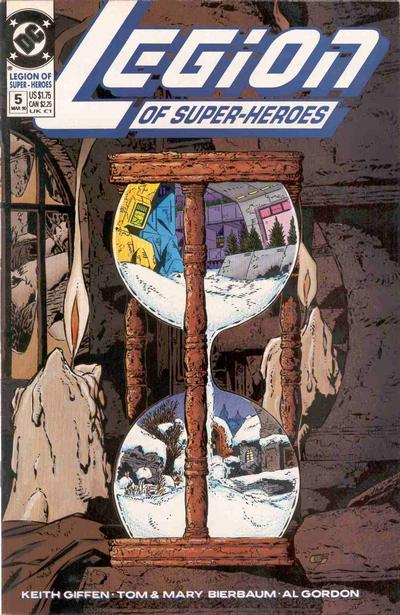
Legion of Super-Heroes Vol 4 #5
Oh, it's a long story. But basically a crazy wizard manages to fuck up history so that magic defeats technology up until even the 30th century. So this single issue is the Medievalized versions of the superheroes trying to get their timeline back. Keith Giffen manages to do what Mike Mignola couldn't and creates the most convincingly Lankhmarish visuals in comics history.
Some people thought Keith Giffen's run on Legion was too dark, too dense, too complex, and too hard to understand. These people are all child molesters. There is nothing like it in the history of comic book storytelling and if we had to lose a few illiterate waterheads off the fanbase in order to see it, then those are the risks of the culture business.
Many more people have never even heard of Giffen's run on Legion of Super-Heroes because nobody fucking reads Legion of Super-Heroes. I envy these people because they can go buy back-issues of the first few years of Legion Volume 4 and be extremely surprised and confused and engrossed and happy for a few days in a way that's otherwise fairly difficult to do without taking off your clothes, leaving the house, getting fat, or paying some creep with weird facial hair for a carefully-titrated helping of something illegal.
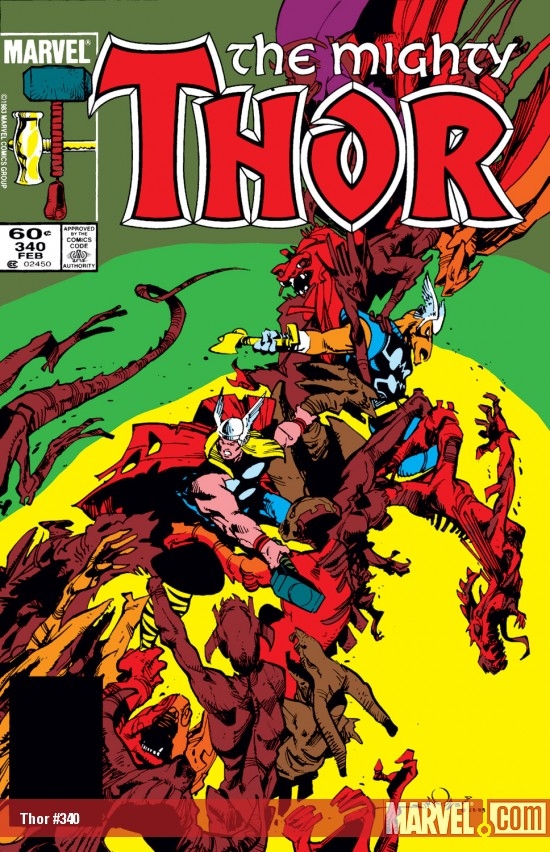
Thor #337-#367
Walt Simonson's run on Thor is exactly what level 15+ D&D should look like: Fire demons and usurpers and lone heroes mauling legions and hordes and bad elves and sound effects that take up half a panel and galaxies on fire and visuals like Viking tracery in a pinball machine. It was worth Stan and Jack making a beardless nordic Superman ripoff with a wingy helmet and six dots on his red-caped costume just so Walt could turn it into this. Check it.
Years later, Simonson did Elric, it didn't work.

Sandman #50
Neil Gaiman's stories always work best when the artist inspires the dizzy wonder he wants you to feel and P. Craig Russel's take on Arabian-Knights-era Baghdad is as dazzling as it needs to be. Planescape fans also must read Gaiman's "Season of Mists" storyline. It is pretty much exactly where Planescape came from. Plus Kelley Jones drew it, so even if you disagree, hey, Kelley Jones.
Speaking of Kelley Jones: Batman: Red Rain is Batman + Dracula so kinda maybe you have to read that and Jones' Deadman is full of horrific-pretty-much-even-the-end-table-looks-like-a-zombie KJ visuals.
_________
There are, of course, many other comics that deal with the fantastic. Did I hear about (your favorite one here)? Bone? Red Nails? Prrrrobably. Did I like it? Probably not, otherwise it would be here in this list. But if I haven't, I'd love to check it out. Good comics are hard to come by.
Sunday, December 18, 2011
How I Like Magic To Work
Dr Strange then explains how the spell shows the target an image of everyone they've ever slain. Maybe no big deal for 90% of foes. But if you're Galactus and eat planets all day, it's exactly the right spell. That's how magic would be, in my perfect worldgame. Devastating when the planets align and the situation is precisely right, otherwise kinda meh.But we don't live in that perfect world/game and this is a game not a novel so I can live with utility spells if they've got enough flavor. We all have to make compromises in this cruel vale of tears.
Even Dr Strange uses a Bolt of Bedevillment half the time. Lazy ass.
Saturday, December 17, 2011
Did I Mention That Fun Was Good?
I had a whole post about how this was pretty much indeed as epic as Jeff made it out to be with some added blather about how you pretty much cannot escape 10 years in art school without hating Frida Kahlo unless you are the hippiest of all possible hippies (and don't know about Dorothea Tanning or Suzanne Van Damme) but blogger ate it. Such is life. I just hope there's a Sol LeWitt vampire down there somewhere.Despite this contretemps, since last sunday I also killed two spirit bears, sicced 3 evil cherubs on the girls who made the PCs blind deaf mute and unconscious not necessarily in that order, got to use 3 thief functions successfully in one fight (climb the wall, hid in the smoke on the ceiling, then backstabbed the Spelleton of Bone Hill)(really probably the first time ever any of that worked. 5th level is nice. Yes, thieves are kind of crap.), saw my dog mutated into a half-troll in the Vats of Mazarin and fended off an attack by the Tedious Weasels despite the cowardice of some of our Crocodile Clan allies. Plus I got to sit around painting Andy San Dimas and her dog Pantera during most of this, discovered that "Carcosa" backwards is "A Soc Rac" and am now eating a spicy genoese sausage with cheese on a chocolate croissant. Who questions this awesomeness?
Wednesday, December 14, 2011
How To Be An Obnoxious G+ DM
Door opens
Zap
Multiple zaps
Warp sound
Laugh Track
Ba-Dum-Tissss
Applause
OOooooOOOOooooooohhhhh
Awwwwwww
Bum bum ba bummmmmm
Shinggg
Death screams
Glass breaking
Spooky wind
Punch
Jungle
Growwwl
ThE WiZaRRrrd
You must die!
...or else you will die!
It burrrrrns!
Youu killed meee!
You saved me!
Love scene
This is illegal you know!
Dear lord! They're back!
We're doomed! Doomed I tells ya!
fuckyeahmetalrollinitiative
Either that was a dimensional gate or you're hallucinating
Castlevania
The Call of Cthulhu spelled wrong but it's a transliteration from an unpronounceable antisonic dimension so, y'know...
Medusaaaaa
Monday, December 5, 2011
The Google, Cut, Paste, Sure-Why-Not? Method
This took an hour.I didn't bother hunting down personalities for the dead people. I figure they're dead, y'know?
Wednesday, November 30, 2011
Of Patience and the Lack Thereof
-"Aaaaalright peeps, if you remember, your are in the ice maze, you are in a room in is forty wide it is thirty north south there is an exit to the north there is a door to the south, you came from the north, there is a statue, you got attacked earlier by an ice lamprey (eeew) there is a pool, in the pool is bluish water and some viking skeleton people, you were chased here by monkeys, what are we doing?"I have a cup of coffee, because it is cold, and I have a cup of Dr Pepper because I am hopelessly dependent on it. I am alternating. I am also playing Schoenberg's Farben for its Ice Labyrinthy and rising mix of cinematic sublimity and teeth-putting-on-edge tinkiness.
My players are looking at each other. The veterans and the tenderfeet. Very quietly. What do we do?
Who is the leader?
Not the most intelligent, not the most experienced, not the one who remembers what's going on best, not even the most charismatic. Not the most anything.
The least patient.
-Local example:
If I (Lord Impatient Imperial Entirely) am DMing and not playing, then the impatience goes like this:
If Mandy has a plan, we're doing Mandy's plan.
If Mandy is absent or feeling too sick to have a plan, Connie does something impulsive from which the party is about to have to rescue her.*
If Connie is absent, Kimberly says "Well fine!" and then hits something. Or throws a switch. Or
solves the puzzle. She's is often a lot like "Ok, well if none of you people are going to step up then so I'm going to do something--as like punishment--and I'm sure it's the wrong thing to do and you'll all be sorry" and then she does it and it's the right thing. Is there a compound German word for that?
If none of them are around, it all becomes very strange. Unless like McCormick is around.
-If the patience equations aren't clear (and they become unclear around the mid-2os each month) you get exchanges like this:
"We go forward!"
"Forward is, regrettably, not a map direction"
"What? I gotta look at the map?...ok...." (shuffle grumble)
"It is indeed a terrible burden, I know"
(shuffle shuffle) "...ok, fine, we go East!"
-I have noticed when I play in G+ games I am real fucking impatient.
-I wonder what goes on in the mind of the patient player when nothing is going on: is it "Whatever, man, it's allllllll gooood" or "Fuck I'm bored but I'm too shy to say anything" or "Fuck I'm bored but I'm not confident enough to say anything and don't want to be the one responsible for killing us all" or "Man it's fun watching Mr Impatient over here tie himself in knots figuring which statue to kick..."
__________
*I recall saying Connie never died last week. I remember now I was wrong, she died in a pit trap I'm remembering now. I think it was a gnome.
Monday, November 21, 2011
Blue But Vicious Rose
"In the high fantasy quests of authors like J. R. R. Tolkien, or the larger than life swords and sorcery of Robert E. Howard, Fritz Leiber, and others, heroic loners or small groups of rebels, outcasts, or eccentrics perform great deeds and go on quests to obtain power and glory or to protect the world from some threat."In the mid-1980s, a generation of new fantasy authors - Diane Duane, Mercedes Lackey, Tamora Pierce, and many others - wrote fantasy novels different from any that had come before. The main characters in their novels occasionally start out as loners and outcasts, but find a place in society, generally as members of some prominent group or official organization that goes on exciting adventures to protect ordinary people from danger.
"Developing a sense of belonging and finding comrades are central features of these novels. Most of these novels are in series, and by the end of the first book, the main character has usually found a community where he or she belongs. Many of the character’s adventures involve either becoming a more fully integrated member of this group or protecting the group from harm...in all romantic fantasy worlds, nature is a positive magical force, and anyone who protects it is on the side of good."
--Blue Rose (Introduction)
"Slaai communicate in enigmas and koans through their crystal balls (with ESP and clairaudience as standard), and can easily overwhelm your tiny monkey brain with mind blasting telepathic insights into their ancient cosmic frog perspective (save vs. death, fail = dead, pass = terror for 1d6 turns)."
--Small But Vicious Dog (Menagerie)

_____
So if you don't know, Blue Rose is a d20-derived hippie version of F.A.T.A.L.--that is, another example of the distasteful and disastrous things that happen when the "fantasy" in "Fantasy RPG" is interpreted as meaning "wish-fulfillment" rather than "invention".
(It is also just all-around baffling. Here's a suggested adventure seed--the whole thing, verbatim: "51. A daring thief steals from the wealthiest people in the city". Um...Good? How is that an adventure seed?)
Small But Vicious Dog is a hack designed to make Basic/Expert D&D emulate Warhammer Fantasy Role Play which is nowhere near as boring as it sounds. Which, well, how could it be? Hacking a third-generation D&D-derivative to match the slightly different rules of a second-generation version of D&D may not sound like a terribly ambitious way to spend a weekend but Chris Hogan rips into his task with terrifying verve.
SBVD is a rules hack, sure, but more than that it's a creepily well-written running essay on all the differences between D&D and its transatlantic counterpart (in micro) and the grimdarkbrutalLOLweird take on fantasy vs. TSR's more catholic let's-just-make-this-game-about-anything-less-boring-than-the-midwest take on the middle ages RP.
_________
Anyway the point is--obviouslyDuh--Blue Rose and Small But Vicious Dog need to be one setting.
For sure.
The DIY D&D Google Plus Brain Trust has been consulted:
(names obliterated to protect the abominationists involved)
"We accept all philosophies in The Magical Kingdom of Chaoldea (*..sparkle sparkle..*)"
"Elsewhere, my zebra skin and long nose were shunned but now I finally fit in (weeping, hugs pegasus with oozing wounds)"
Tell me that would not be awesome: not just your typical "something's not quite right in Stepford Camelot" set-up, but one where just every citizen is oblivious to the fact that all the symbols are always pointing in the wrong direction.
There's like an eight-gulleted Negaboar vomiting on children in the streets and ripping their ears off and wearing them like legwarmers and everyones' just like "He's just expressing himself!" The kingdom's main export is tediously optimistic NPCs found in random oubliettes. "Oh I'm so glad you found me! I've always believed the human spirit was powerful enough to triumph over any adversity!"
Do the Chaoldeans have secret plans to spread their utter lack of prejudice and imagination across the entire continent or is it just a very disturbing place to go buy a unicorn-hoof talisman? Hey, you're the DM, it's up to you.
Monday, November 7, 2011
One Simple Step To "Weird"
Not weird:
Ptolus is a major city of about seventy-five thousand people. It is located in the land of Palastan near a large bay on the southern end of the Whitewind Sea.
Weird:
Vrokk is a major city of about seventy-five thousand people. It is located in The Empire of Madness near a rock island floating 30' in mid air on the southern end of The Cerulean Forest.
Not Weird:
...it lies in the shadow of an impossibly tall (almost three thousand feet) and thin pinnacle of rock known simply as the Spire.
Weird:
….it lies in the shadow of an impossibly tall (almost three thousand feet) and thin pinnacle of rock known simply as the Tower of Inexplicable Idiocy.
Not Weird:
If the stories are correct, these catacombs include:
1.The sewers of the city.
2.Vast stretches of subterranean passages and chambers created by Ghul and his minions
3.The remains of an even older city.
4.An abandoned underground dwarven settle- ment called Dwarvenhearth.
5.And levels that plunge incredibly deep below the present urban area.
Weird:
If the stories are correct, these catacombs include:
1.The divination chambers of the Tenebriate Guild.
2.Vast stretches of subterranean passages and chambers created by Screel Hak and his minions
3.The remains of an even older city.
4.An abandoned underground jackalman settlement called Naqqara .
5.And levels that plunge incredibly deep below the present urban area.
Not Weird:
The city is ostensibly ruled by a council, at whose head is the Commissar, a representative of the Empire of Tarsis. The other main council members are Kirian Ylestos, the Prince of the Church, and the Mother Superior of the Sisterhood of Silence (see below). Other City Council members (with less influence) include guildmasters, the heads of the noble houses, and a few wealthy merchants. People of the town often refer to this body as the “Council of Coin,” because money is a powerful and influential force among its members.
Weird:
The city is ostensibly ruled by a female beggar, whose half-coherent alcoholic ravings are interpreted by agents of the Empire of Madness. These agents are Stoya Sel Nirik, the Baroness of the Fourth Doom, and the Child Inchoate of the Sisterhood of Need (see below). Other agents (with less influence) include guildbarons, the heads of the houses of mathematics, and a few wealthy choirmasters. People of the town often refer to this body as the “Council of The Drowned,” because their meetings take place in chambers half-filled with plum-colored liquid. (This ensures civility, as violent disagreements inevitably result in one or the other of the contenders being knocked from his or her floating platform into the poisonous ichor.)
Not Weird:
Helping to enforce the law is a special order of monks called the Sisterhood of Silence. These nonspeaking female monks patrol the streets and apprehend criminals, even though they are not— strictly speaking—sanctioned to do so officially. A male eunuch always accompanies a small unit of the Sisters of Silence to speak on their behalf.
Weird:
Helping to enforce the law is a special order of parasites called the Sisterhood of Need. These small, moist beings dwell in the ale sold in low haunts and crawl into the stomachs of criminals, even though they are not— strictly speaking—sanctioned to do so officially. A male eunuch always accompanies a small unit of the Sisters of Need to speak on their behalf.
Thursday, October 27, 2011
Clarification
Friday, August 26, 2011
Let's Read: something depressing!
People send me stuff. Let's see what we got...
Tons of WOTC stuff. It's all so long...
Ok. shortest:
"The Slaying Stone, an adventure for characters of 1st level" by Logan Bonner.
Oh let's rip this apart. Should kill and hour before lunchtime...
Amazon reviews:
"Doesn't Railroad the Players"-somebody
"This module is different from the previous ones published by Wizards of the Coast. Up till now their modules were very linear, and the DM had to lead the players from one area to the next. This one presents an area that is more of a sandbox."-someone else
"The author of The Slaying Stone, Logan Bonner, has allowed plenty of room for improvisation by experienced players/DM's. For Novice DM's however, it may not be the easiest module to run, as it seems like it will require a lot of "thinking on your feet" and spontaneity. " -some total other person
Maybe it's not terrible? Is this possible?
Well it's the shortest, so we're doing it. It's this or the Psionic's Handbook.
Cover: The cover is typical anime-influenced-but-colored-by-a-mud-golem-and-detailed-enough-to-look-expensive-despite-a-total-lack-of-any-interesting-details-in-it WOTC product. It is truly the least awesome take on "fucking wardogs made of fucking metal" anyone has ever painted.
Art lesson for Ralph Horsley:
Incorrect:
Correct:
Let us discuss you no more.Introduction, Background, Synopsis, and "Running this adventure" (and the credits) all fit on one page!!!!!!!!!!!
Reads like a shockingly efficient piece of work so far. No fan fiction at all! It realizes I don't need to know what the Empire of Nerath is! I am excited. However, a tocsin note is struck during the synopsis...
"After exploring several dead ends, the characters find the stone in the lair of a powerful brass dragon, and they must convince the dragon to relinquish the stone. The orcs appear again, ambushing the characters in order to steal the item."
So you must by definition explore several dead ends? And the orcs must show up at the end? You can't just notice they're following you and ace them early? Let's be fair and wait and see...
I am going to leave aside the obvious point that this is a first level adventure where you fight kobolds, goblins and orcs (oh, and a hobgoblin) and how that is and always will be a way of going "Hey, I know you're paying for this and all, but I'm not really trying here--or, if I am, I'm a very boring person" because:
-I bet someone told poor Logan Bonner he wouldn't get paid unless it had kobolds and goblins and orcs, and
-What the fuck did we expect?
Opening scene...
Logan and/or WOTC overlords lose 20 points right off the bat for including this...
Read:
A cold wind whips sleet at you and...(blah blah 6 lines of this crap)...toward the safety of shelter.
To be fair, Goodman Games also loses it for having "read me" boxes all over its new Dungeon Crawl Classics adventures as does TSR for inventing "Read Me" boxes. Fuck all such boxes ever.
We lose another nigh-unavoidable-in-this-decadent-age 20 points for taking a whole page to say "the PCs fight some wolfs". However, once we grant that, the details of the encounter are not terrible: mud slows everyone to half speed, there's a bridge to cross to get to shelter, when PCs get close, someone goes "Hey, come to the tower," and lends a hand, and the wolves' tactics are good: they're hungry, so they're just aiming to knock over one PC, drag it off and eat it.
Oddity: Once past the wolves, the PCs get an infodump which is basically their mission briefing. Fair enough. But why did we get 7 lines of "Read me" text up there earlier the beginning basically to say "it was a dark and stormy night" yet the whole mission precis--which, detail-laden as it necessarily is, is one of the few things that actually might lend itself to pre-written speech ("Now, listen up 007, it's come to our attention that...")--in just 'DM-eyes' format? Odd.
If you're going to violate one of the most basic rules of DMing and fucking read text at me, then why not read text you might actually need notes for?
Basics: McGuffin. Map of possible locations. There's a ritual helping you find it--you can only use it 3 times.
2 bonus points for Logan B: there are 5 books of value in the town besides the mcguffin. If the PCs think to inquire, they can collect them for more xp, and the DM decides where these books are hidden. Mr Bonner loses points for not mentioning that the contents of said books can be generated using Vornheim: The Complete City Kit, available from Lamentations of the Flame Princess press for only 12 pounds 50 plus shipping act now get yours today!
Sorry. Anyway:
What we got here so far as of page 5 is basically a nonlinear location-based adventure where instead of a dungeon we have a town overrun by goblins. Also: there is treasure other than what the quest-dispensing NPC knows about. So far neither railroad tracks nor creativity are visible.
Now we have a rundown of the major NPCs...
Note--never write like this: "Like his piercing stare, Vohx's heart is cold as ice." On top of the million ways reading that sentence makes you dumber, you are wasting space telling us (again) that the leader of the Severed Eyes Orc Clan is bad.
Pages 6 and 7.
Oh, I like this:
The characters can visit the parts of the town in the order they want, so they might end up exploring areas or talking to NPCs that aren't detailed here. If your players don't know what to do next, or if you're looking for something new to include, invent something that ties back to the plot themes listed below...
So there's the kind of things characters in the town might talk about. The possibility of convincing the kobolds to attack their oppressive goblin overlords is included, as are several possible alternate "plot-threads" that could come up. These are very much in the "my first adventure" vein, but none are terrible. But still, jesus, I sound like a kindergarten teacher "Hey, none of you ate your paste! Rock on!"
Map key notes:
-Monsters everywhere. Aside from the default low-end-of-the-humanoid-bell-curve already mentioned, this adventure also has a dragon in it. (You don't fight it.) On the one hand: monsters are cool. On the other hand: late-era D&D sort of has a tendency to go "Why have a corrupt monk when a bugbear and 2 nagas will do?" thing going on which sucks the scary right out of monsters. It's your first adventure ever, you meet a dragon. Maybe this is terrifying and so it works. Maybe this just gets you so used to talking to dragons that they are really nothing special forever after. Hard to say.
I wouldn't have put it past WOTC to have told Logan B "Oh, also, it has to have a dragon in it".
-The goblins in this town have a temple to their goblin god. It is not made weird or interesting. Calamitous missed opportunity on the level of the cover artist's metal-dogs' insufficient metalness.
-Missed Opportunity #3 (Minor) "5. LOOTING GROUNDS (TRADE DISTRICT)
From the ruins of smithies and vendors' stalls, the goblins and kobolds have scavenged every little scrap they could find."(That's it. Searching reveals nothing.)
-Missed Opportunity #4 (Major) "Goblin graffiti decorates the trunk." (No examples given.)
-Philosophical question suggested by Missed Opportunity #4: if WOTC is determined to use "official" versions of monsters in published products, why shy away from giving them a little detail, like they do with devils and demons? Because they need them to be generic enough to fit different GM's settings. So: a nether zone--they have to be standardized because D&D is now a brand, yet they can't be distinct because it also has to be generic. Really makes you wanna play Warhammer dunnit?
-Ummmm... "The goblins keep drakes, wolves, and other dangerous beasts in the stables the Kiris family once maintained." And that's it. Just a bunch of weird creatures here, move along... Ok, accepting the whole "yeah, D&D land is just wall-to-wall (standard) monsters" thing and moving on, are we seriously expecting the PCs to just leave the monsters alone? I'm not usually a guy to demand more stats from WOTC, but when my players decide to unlock the stables and send these drakes, wolves and undifferentiated teratofauna out into the village to act as a distraction while they hang out on the roof with crossbows I might kinda wanna know how many hit dice these things have. Is this a rare burst of efficient module design (hey, make it up yourself, DM) or WOTC just failing to realize PCs might do something other than use their Encounter Powers to move through Encounters in order to fulfill a Second Level Quest?
-mmmm... Brass Dragon lair dug into sandy soil. Brass dragon has already left scales, scorchmarks and clawmarks elsewhere. Yet "Unless the characters are searching for a lair, they need to succeed on a DC 20 passive Perception check to detect the lair's entrance." No footprints? No reference to the dragon covering its footprints? No reference to what, physically, you would be looking at with your "perception check"?
Page 10
The Slaying Stone of Kiris Dahn cannot be sold. It's right there in the rules. Despite the fact that it can be used to kill anybody so long as they're in the town of Kiris Dahn, nobody wants to buy it, ever. That's so dumb. If you just had to limit the stone so nobody would get rich selling the instakill pill why not just say it's magically enchanted so it can't leave the town (it would also be a convenient way to explain why the NPCs are so sure it's there in the town somewhere).
Encounters
More quasimandatory lameness. Getting into the goblin town (through the forest, over the river, or past the front gate) is described solely in terms of skill challenges. Now through the forest (sneak through trees without being seen) or over the river (swim the river and don't make a lot of noise or drown) this kinda makes sense and could be described in a similar way in a lot of games, but for the front gate this is bullshit. We need some goddamn guards with a goddamn guardhouse and the PCs need a goddamn plan to bluff past the goblins or jump over it and seriously if you can't make up a guard house stop writing modules and if you can't think of a plan to bluff or sneak your way past one, stop playing D&D. Completely fuck this abstract bullshit. This is the game. You are skipping playing the bestest parts of the game with your fucking skill challenge.
And if they don't recognize the opportunity for Complex Tactical Combat when you've got one PC over the wall, two PCs behind the wall, one on the roof, and one in the middle of the gatehouse pretending to be a goblin's granny when they are all discovered then, really, what is Type IV D&D for?
In the same vein, Encounter 3 is just a gross weird totally Type 4 shibboleth. It is basically trying to explain how--using skill challenges--the DM is supposed to describe getting around the town secretly and/or failing to do so. The basic idea--be subtle or end up in an encounter--is reasonable, but the lack of detail and the inability of the author to write (or be allowed to write) "Hope the PCs think up a clever plan using their real actual brains or they're toast" is depressing. And every noncombat problem that is described apparently has to include at least 3 examples of skill checks you could use to get past them. The space used to write out all this wonky skill challenge bullshit could've been used to have a "5o random get-past-the-goblins situations" table.
People who both run 4e and have functioning brain cells have all kinds of philosophical positions about how to make skill challenges not ungodly tedious exercises in rolling-where-thinking-should-be but one gets the definite sense here that pages and pages of design space have been given over to make the (narrow) mechanics fit the (complex) situation here.
Vault of the Drow would've been a novella if it'd been written this way. Thank god it wasn't: there's a bad elf on a giant lizard--figure a way past it, numbnut!
Note: Encounter 7 is entitled "Monsters and Manuals".
A weird thing: "This encounter can occur at the monster pens (area 7 on the Kiris Dahn map) or in some other location of your choosing." Wait but back when I was reading about area 7 it didn't direct me here...
This is a weird thing about this module: the whole thing is abstracted--we don't have the whole goblin town laid out (fair enough, it's big) yet WOTC D&D demands each encounter be attached to a place with a battlemat. (Why? They don't even sell minis anymore do they?) So we can't just have traditional "random encounters" where a group of monsters just appears whenever in certain areas, but they also don't seem to want to say "here's a map, this encounter happens when you go here to this place"--at least not consistently.
Instead they seem to be saying "this encounter happens here, this one happens here and the rest sort of just happen when you want them to if the PCs are in the kind of place where it might happen". While it's nice they're giving you options, it seems like kinda pointlessly adding an extra step for the DM and severing the (usually rather useful) connection between the map and the fights that are on it. At this point I'm honestly not sure what they're after--is the idea to put the "right" number of combats in front of the PCs before they get to the next plot point (if so, that's dumb)? (spoiler to the end of this read-through: it is.) All I can say for sure here is it's confusing and they probably could've explained/designed it a little clearer. There is no table or chart describing the connections between all the encounters and the applicable trigger actions.
Or, to put it another way: this is an awful lot of rules and pages (20) if they're just saying "Here's a bunch of monsters, have them fight the PCs whenever you want."
Encounter 10: Hideous endless skill-challenge-damaged description of how to do a role-playing encounter with a dragon. So many trees died so that your players wouldn't have to think or imagine, Hasbro. So many.
Obvious mistake: the Orcs trailing the PCs attack after the PCs get the stone. There should've been ways for the PCs to detect them all along. Definitely definitely.
Encounter 11:
PCs talk to person. Goblins interrupt to attack person who is actually ratman. Goblins attack ratman and PCs. Ratman attacks PCs.
Wait, why? Why wouldn't the ratman attack the goblins? Or at least both the goblins and the PCs? It's not explained. He's a monster on a battle grid. He doesn't need a reason.
Encounter 12:
"Scouts constantly monitor the area, so it's nearly impossible to sneak up on the mansion. That said, if the adventurers devise a clever plan to sneak in, run with it!"
(but, naturally, neither the area, the goblin's work schedule, nor the scouts are described--no matter how long you stake out the area or what you see them do, the foes will be in exactly the same place on the battlegrid) Hmmm...split personality much? It's like the Type IV people either wanna design a whole skill challenge or just say "fuck it". No in-between. Weird. It's like saying: "There's a wall here, it's this tall, and 2 guys standing here" and just let the GM figure out the rest isn't enough. And consequently the whole place is either totally overdescribed combats or underdescribed noncombats.
_________
Conclusion
Here's what happens if you keep the magic stone instead of giving it to the NPCs...
"The two NPCs hire another group to take the slaying stone from the characters. Since the stone doesn't function outside Kiris Dahn, it's about as useful any other heavy rock."
Um, dude, again, if you can't think of what PCs could do with a magic item that can kill anyone as long as they lure the target to a certain place, you're hopeless. How awesome would your campaign be if the last thing your 25th level thief did is lure Tiamat back to the redneck goblin village where the campaign began, so many years ago...?
In other news: treasure parcel checklist: 4 magic items already. Ew.
___________
Page 31 explains a lot...
"If the adventurers bypass encounters or if you plan to get them more XP over the course of this adventure, you can include some of the following encounters..."
This sentence explains a lot.
Ok, so the adventure is worth a certain amount of xp.
This is because the encounters (skill challenges and monsters together) are, combined, worth a certain amount of xp.
This means that if the PCs skip encounters they are expected to have the adventure is worth less xp. That's bad.
However clearly this adventure is supposed to have an "open" structure: enter from any of 3 directions, go to any of 3 places, muck about until you have enough clues to go where the mcguffin is.
It would, therefore, be easy to "skip" encounters.
So, two things have been done to fix this problem (a problem created by the module's rigid adherence to Type IV D&D's xp regime).
#1 "Bonus" encounters are stuck in in case the PCs skip planned ones.
#2 Half the encounters can just happen whenever the DM wants.
The overall effect is: no matter what path the PCs choose, and what tactics or strategy they choose, they will get in exactly the same number of fights with foes of exactly the same total strength.
So it's not a railroad but it is. Because although the PC's have choices, these choices have very little effect on what their experience is. The choosing is not part of a process of problem solving, it is a process of accidentally choosing Monster A over Monster B. At least as written.
The meaningful choices only happens during combat. What a rip. The whole point of trying to decide how to infiltrate a city is to avoid fighting--or at least to fight on your own terms--and almost nothing in the adventure supports that.
A whole level of play has been removed. One of the most interesting ones.
That having been said...
...you could easily ignore the xp system and just make this into a plausibly decent adventure. It's not the world's most ambitious or inventive adventure (fighting kobolds, goblins, hobgoblins and orcs to find a magic rock) but it is entirely devoid of bards, druids, gnomes, brain moles, owlbears, cave fishers and infantry mounted on gryphons so, aesthetically, it could be worse. TSR did worse a million times.
For the fuck of it--let's take a look at what would have to be done to turn this from a set of railroad cars into a genuine adventure (that is, a complex and multi-layered problem to be solved by humans with heads):
-Ok, the encounters would have to actually be fixed to locations on the map, or to a friction point system where failed skill challenges (or other displays of sneakiness ) would bring on specific encounters. (See how already this fucks with the program: this means you'll miss encounters and get less xp for doing the smart thing. If all PCs want is xp, you're screwed--they'll be stupid for the hell of it. Or you have to use a different xp system.)
-There should be more actual locations on the map, with multiple possible routes to the 3 objectives.
-Means of scouting the city should be better described. How hard is it to see what's going on? Once you're up there, can you plan a specific path through or do you just get bonuses to your various sneakiness rolls?
-Important buildings (gatehouse, hobgoblin's lair) should be given enough detail that the PCs could actually decide how they're attacking them. Even with the adventure written as-is, a PC should be able to climb up to the roof and ready a crossbow (or something worse) covering the front door while another PC rings the front doorbell. But how high's the roof? How climbable are the walls? Treat the environment like it's real.
-Specific encounters and/or locations should be seeded with specific clues pointing to the dragon with the mcguffin and the orcs that are shadowing the PCs.
-The actual location of the orcs shadowing the PCs at any given time should be nailed down, not left to "float" until after the PCs get the mcguffin.
That's a lot of work.
____
Ok, so what?
Pretty much all modules suck. And the whole idea of modules mostly sucks (write your own goddamn deathmaze, lazy ass). So why pick on this one?
Because it demonstrates even with an author with the best will in the world making a conscious effort not to write a railroad the basic requirements of new D&D push published modules in the more-sucking direction. Most of this is not your fault, Logan Bonner, it's the fault of the people who hired you to write this thing with your hands tied behind your back.
Type IV DMs can run whatever adventures they want (just like everybody else) but if they want to get them published they have a ton of hurdles to jump:
-The difficulty scale and brandification means standard versions of monsters have to appear. (Or else, presumably, versions specific to official brandified settings--equally a snore.)
-Brandification also (apparently) requires that every illustration has to look like an earth-tone claymation version of Warcraft trade dress.
-The xp system requires the adventure to contain a set series of linked encounters adding up to a predictable amount of xp given for encounters only--dramatically reducing the possible kinds of adventure formats.
-The abstract nature of this kind of "encounter chain" format means the physical world is abstracted so much you pretty much have to make up anything not nailed to the battlegrid. So what's the module for?
-The separation of encounters into "skill challenges" or "combat encounters" means a certain amount of space (usually a whole page) is given over to describing any possible friction between the PCs and the setting. Rather than describing everything a little and trusting the rules to explain the rest, everything's either described a fuckton or not at all.
-That plus all the graphic design padding means there's no room for stuff like what's in a goblin temple. (Either that or they hired an author who doesn't care what's in a goblin temple, in which case they suck forever hopelessly.)
-All of this put together means Type IV D&D modules are so stylized and so specific to their own system that they are what almost no other module is--almost useless for any system except the one it was designed for.
_______
Anyway: unlike me, a lot of people interested in DIY RPGs learned a lot of what they know from modules. Apparently they learned a lot more from modules than I ever did because they managed to figure out how to DM anyway, and some are pretty good at it. I shudder to think what the new kids coming up are gonna do if they have to build everything they need to know about running a game from this crap.