Attitude one:
Like pre-modern art, the game is like a window into another world. Just as brushstrokes and picture frames are considered necessary but distracting elements in a traditional painting, dice, rules, Cheetos are necessary but distracting elements in the game. Whatever can be done to limit their hold of the mind of the player and promote pure immersion is appreciated.
Attitude two:
Like modern and postmodern art, the game attempts to be a window into another world but it also unavoidably a window into the people involved. As in any game, the dice and the rules and the Cheetos are palpably there, just like the brushstrokes and the picture frame are palpably there in any painting and it is hopeless to ask the audience to ignore them and doing so only highlights the falseness and irrelevance of what you're doing. So, instead, make these things fun--if it is in the players' consciousness, use it to your advantage. Whatever can be done to seize on an element at the table--a table, a rule, a chart, a miniature, a sound in the room, and make it part of a gesamtkunstwerk (albeit one collaged from disparate elements) is good. If there must be a Cheeto, use the Cheeto.
Monday, May 16, 2011
Sunday, May 15, 2011
Random Levelled-NPC Drop-Die Chart
 This is not-simulationally-weighted chart for generating levelled NPCs with a single die roll, so it's good if you need NPCs fast in the middle of the game--especially if the players are watching.
To generate an NPC, drop a d4 directly onto the chart. Look where it lands: read up to see the NPC's race, read left to see the NPCs class, look at the number on the die to see the NPC's level.
(For some classes, there are additional rolls that can be used to generate class-specific details.)
To generate a whole party of NPCs at speed (a task for which this kind of chart is unusually useful) drop a handful of D4s onto the chart.
To generate a higher-level NPC you can either use a bigger die (note: dice larger than d4s tend to roll and slide a bit and so possibly roll off the chart, though you can put the chart in a box top and roll that way) or you can interpret the d4 as being like: a 1 = PC level minus one, 2= PC level minus two, etc. Or whatever variation on that fits the situation.
____
p.s. The guy who published Vornheim will yell at me if I do not point out that that fine publication pioneered tables like this and has some in it so, y'know, you should buy it.
Saturday, May 14, 2011
Random Spacemonster Generator
 A bizarre silhouette of gargantuan proportions shambles into the lurid mesh of wire, halogen and indicator light...
This table has been playtested once for FASERIP and was grotesquely successful, it can easily be adapted to any sci-fi game, though since it's at its most effective when the "veil" is pulled back it's better if you are cool with that playstyle...
"Roll a 6-sider..."
"Um, ok...5?"
"It's a 'Thraxian...' roll again."
"3"
"'...war'...' roll again."
"6"
"'...squid from planet...' roll again."
"1"
"'...Twelve'. It's a Thraxian Warsquid From Planet Twelve."
(Players happy.)
(Fun obtained.)
(Small rubber toy placed on board)
(Players happy again.)
(All details of size, limb arrangement, means of locomotion, etc. will match the toy used.)
(Battle commences.)
___________
Ok, roll 3d6, one at a time.
(Any rule or 'crunch' detail specific to the Marvel-Superheroes RPG will appear in blue: assume FASERIP stats of: GdGdAmMnFeFeFe. Assume no Karma. Assume power rank of any abilities is--duh-- Monstrous.)
(Health = 150 + 10xnumber rolled on first d6 here)(Yes I realize this is not the canonical way to calculate FASERIP health scores. The Thraxian Glaxothrox annihilates all human mathematics with its eyebeams.)
1. Gorgallian
2. Vortaxian
3, Zortakkian
4. Polarian
5. Thraxian
6. Karkalian
1. Throg- (swallows foes)
2. Glaxo- (eyebeams)
3. War- (horns or claws, S:Un E:Un)
4. Gorgo- (radiation breath)
5. Slime- (supersticky or superslippery)
6. Zergo- (sonic shriek)
Body armor = 10x number rolled on third d6 here...
1. -worm
2. -throx
3. -beast
4. -squid from Planet (D6: 1- X 2- Z 3- Twelve 4-Zool 5- Crax 6- 99)
5. -sphere
6. -crawler from Dimension (Have players roll a d10 and then just pick a number that sounds cool and isn't the number they just rolled. Dimension Nine is the default.)
 (superhero counters used during playtest, front row L to R: The Thing (sculpy), Wolverine, Mister Fantastic, Spider-Man (can't tell but it's done with Sharpies), Thor)
Thursday, May 12, 2011
Every Single Way I Can Think Of To Start An Adventure
First, from the point of view of the characters in the game (not the people playing), there are two basic ways to start an adventure:
1) Hope: The PCs want something to happen and go after it.
2) Fear: The PCs want something to not happen (or stop happening) and take steps to prevent it.
Some things about this:
-Lurking behind these is the idea that the players do or do not want something to happen (they want to level up, they do not want to suddenly not get to play with their current character 'cause it just died, etc.)
-Villains, rogues, and explorers are traditionally motivated to go on an adventure by the hope of making things better for themselves whereas heroes are more traditionally motivated by fear of the bad guy doing something bad. There are lots of exceptions and different ways to read this but if you click on that link there you'll probably see they're all covered so if you want to argue about whether Frodo was more motivated by hope for a better world or fear of Sauron being the boss of all the stuff and shit, then just remember, as an adventure Frodo's story starts with him trying to prevent something. Anyway this isn't that important to the point I'm making here now...
-Either way, all these Ways To Start An Adventure are highly dependent on 2 things: what your individual PCs (and players) want or don't want, and whether you're starting an adventure ex nihilo or doing it in the middle of a campaign.
-Hope is often more interesting than fear, theoretically, because it gives the players more options, however fear is often easier and more efficient for squeezing the PCs out of indolence and into action. Plus with hope you need to know what your players want, whereas with fear you don't.
-I am going to limit these Ways to Start an adventure to traditional RPG systems where player input into the setting, events, world, etc. is limited to what their own PC does or is otherwise limited by GM fiat. Otherwise the task is actually a lot easier since asking the players what adventure they want to go on is sort of programmed into the system one way or another. "You want to do a murder mystery?" "Yes""Ok, you're looking at a body..."
Ok, ways to start an adventure:
-Wake up incarcerated Love this one. All the GM needs is an interesting location surrounding the PCs and the first day of adventure writes itself. Downside: Though as a campaign starter it rules (hey, every campaign has to start somewhere) you usually can't use this in the middle of a campaign unless you're a total dick. Oh yeah, I know you checked into an inn at the end of last week but now you're in jail, sorry about that. I elided time, GM's prerogative and all...
-Geographical isolation The PCs are in some location surrounded entirely by adventure locations (a typical sandbox set-up). This is essentially the exact same as "Wake up incarcerated" only on a bigger scale and with hope instead of fear as a motivator. There are more options off the bat, usually. The PC chooses someplace s/he wants to go rather than knowing s/he has to get out by any means possible. Downside: Unless you want to give the PCs basically only one place nearby to go (in which case, why not just start the adventure there?) then you have to have either a lot of locations prepared or be ready to improvise a lot.
-Geographical isolation plus "stick" This is like Geographical Isolation only with one or more "sticks" (as in "carrots and sticks"): you're out of fuel, you're out of food, you need spare parts. Important: the PCs don't necessarily know where the food or fuel or spare parts are so it's still an exploration game. In reality, even ordinary Geographical Isolation has the stick of boredom for the players if they don't pick an objective--but what objectives they pick and when they'll stop is a little more clear if there's an in-game stick.
-Roll Initiative! Like Wake Up Incarcerated (WUI is better 'cause you start with some player interaction and problem solving) but it's more flexible since you can use it in the middle of a campaign. Downside: If the PCs win the fight and aren't captured, it won't automatically start an adventure--will the PCs wonder why they were attacked? Not necessarily. Basically you have to think up another hook/starter on top of this to be sure you start an adventure with it.
-Hey, Look--Shiny! Pure Hope here. The PCs see something they want remotely, behind some barrier, hear about it from an NPC, notice a very obvious sign of it in the environment or in the hands of another. Like always with hope, this only actually starts an adventure if you are sure the PCs will want the thing seen. A common version of this is any time the PCs are set up to notice that some NPC will pay money for some thing being done. Most classic-era published D&D adventures start this way.
-Curiousity Something strange happens. The PCs look into it and find adventure. Downside: Unless the strangeness affects them in a bad way (in which case it's basically Valuable Thing You Had Is Taken--see below) they hardly ever do look into it, since they got their own shit to do, unless there's an element of...
-Genre Obedience The players (not PCs) know that a hook is being placed in front of them and agree to go along with it because they know this is where the adventure that the GM bought or thought up is and know that if they're agreeing to roll up characters and play at all then they're agreeing implicitly to do this thing because they thought it would be fun and if they don't they have no-one to blame but themselves. Your uncle dies raving about a mysterious cult. So what? He was obviously crazy...No, wait, this is Call of Cthulhu--if you don't decide to investigate you might as well not play. Downside: While not necessarily the horrific burden some people make it out to be when discussing it in the abstract, this way to start adventures gets less and less useful as a campaign progresses and the PCs develop distinct personalities and the players develop interests in- and aversions to- specific parts of the setting.
-Valuable Thing You Had Is Taken On the one hand: this sure does work. A player who would not cross the street for a mountain of Treasure Type M will fucking scour the solar system to get back a pair of tweezers an NPC stole. Downside: if done improperly, or if done with some item or ability the player strongly identifies with the character (Spider-Man's web-shooters, say), some players will just get depressed and feel like they're not "getting anywhere" (even if the request to get the web shooters back nets them a lot of xp). They signed up to play a guy with web shooters and they want to play a web shooter guy, dammit! Or they found a magic ring and they want their ring, dammit! Plus it's hard to guarantee an NPC or monster gets an item away from a PC and if you build a whole adventure around that it could get mutilated fast if the PCs are clever enough to keep the macguffin. Make your thievery attempt at the end of a session. If it succeeds, then write your adventure around it.
-Threat To Something The PC Theoretically Values But Doesn't Own Someone tells the PC their country/religion/mom etc. is under threat or they discover evidence of it. This works fine so long as every member of the party actually values that thing or can be trusted to go along with the PC/player who decides to take action.
-Mission PCs get a choice: do a thing or have a fight with the people who want them to do the thing (if there are no consequences and they're just doing it for money or out of kindness, it's one of these other starters. If the PCs won't really have a fight and will just be annihilated if they don't wanna do it that's pretty much just a railroad and fuck that.) Pretty classic and easy all around. Downside: Like Genre Obedience, it can get old after the campaign's been going a while.
-PC Out Ahead of You Kind of like Hey, Look Shiny except instead of the PC finding out about something s/he wants, the PC decides to seek some objective that is implied by the setting but which the GM hadn't really given much thought to, like: Well, yeah, I guess you can sail east off the edge of the map, don't see why not...Downside: The major downside other than the fact that, for obvious reasons, you can't, as a GM, plan this, is that the other PCs have to stay equally invested or else you're dealing with a split-force campaign which can be logistically annoying.
-Parachute In And Roll Basically the GM has a whole interlocking miniworld ready to go, much of which is explained to the players up front. The PCs then get to make lots of decisions like where they start, on whose side they start, etc. etc. Downside: Requires a lot of work for the GM even before the game starts, and a lot of paying attention to this campaign material from the players.
-Looming But Not-Yet-Present Threat To PCs Themselves A lot like Geographical Isolation Plus "Stick", though the PCs do not necessarily have to be geographically isolated, they could just be in a well-defined world (or one the GM's willing to improvise up as the game progresses). Like Parachute In, the PCs will have to be given a lot of information in order for their freedom to deal with the threat as they please to be meaningful. If they are only presented with pre-canned methods of dealing with the threat, it's just a "Mission", really.
-The "Seinfeld" Like Geographical Isolation except the GM does not use geographical boundaries to slow PC progress. Like if they're suddenly all "let's go to India" then, no problem, they're suddenly in India later in that same session. The GM may either slowly introduce hooks and/or obstacles, like in Geographical Isolation, or bring in any other adventure-starter on this list. This can be entirely improvised, possibly based on what the PCs say while they're trying to figure out what's going on.
-It's A Long Story All the PCs are wherever they are for different reasons based on their history or personality or job. Like: you're the translator, you're the bodyguard, you want the Flower of Almon-Grealle, you need to kill three of the other PCs to get a reward, etc. The defining characteristic here is that each PC has a different motivation and they have to sort of argue it out in order to figure out even what kind of adventure they're having.
-Stages of Defined Choices The group has to make some decisions, right off the bat: though these are framed as in-character decisions specific to the kind of adventure the GM is going to run (which route will you take, what are you driving, etc.), they do not take place at the normal game time-scale and essentially help the players define the adventure. It's an in-between step: ike after the players have generated their characters individually, they have to work together to generate something else before they play. The nice thing here is it immediately gets the PCs invested and involved in the set-up in a cooperative way. Some other kind of way to start an adventure usually will have to be bolted on the end after this one.
-Combo Roll twice on this table..
That's all I can think of for now. I thought of about a million others that, after analysis, basically fit one of these options. If you think you've got one I totally missed, comment.
1) Hope: The PCs want something to happen and go after it.
2) Fear: The PCs want something to not happen (or stop happening) and take steps to prevent it.
Some things about this:
-Lurking behind these is the idea that the players do or do not want something to happen (they want to level up, they do not want to suddenly not get to play with their current character 'cause it just died, etc.)
-Villains, rogues, and explorers are traditionally motivated to go on an adventure by the hope of making things better for themselves whereas heroes are more traditionally motivated by fear of the bad guy doing something bad. There are lots of exceptions and different ways to read this but if you click on that link there you'll probably see they're all covered so if you want to argue about whether Frodo was more motivated by hope for a better world or fear of Sauron being the boss of all the stuff and shit, then just remember, as an adventure Frodo's story starts with him trying to prevent something. Anyway this isn't that important to the point I'm making here now...
-Either way, all these Ways To Start An Adventure are highly dependent on 2 things: what your individual PCs (and players) want or don't want, and whether you're starting an adventure ex nihilo or doing it in the middle of a campaign.
-Hope is often more interesting than fear, theoretically, because it gives the players more options, however fear is often easier and more efficient for squeezing the PCs out of indolence and into action. Plus with hope you need to know what your players want, whereas with fear you don't.
-I am going to limit these Ways to Start an adventure to traditional RPG systems where player input into the setting, events, world, etc. is limited to what their own PC does or is otherwise limited by GM fiat. Otherwise the task is actually a lot easier since asking the players what adventure they want to go on is sort of programmed into the system one way or another. "You want to do a murder mystery?" "Yes""Ok, you're looking at a body..."
Ok, ways to start an adventure:
-Wake up incarcerated Love this one. All the GM needs is an interesting location surrounding the PCs and the first day of adventure writes itself. Downside: Though as a campaign starter it rules (hey, every campaign has to start somewhere) you usually can't use this in the middle of a campaign unless you're a total dick. Oh yeah, I know you checked into an inn at the end of last week but now you're in jail, sorry about that. I elided time, GM's prerogative and all...
-Geographical isolation The PCs are in some location surrounded entirely by adventure locations (a typical sandbox set-up). This is essentially the exact same as "Wake up incarcerated" only on a bigger scale and with hope instead of fear as a motivator. There are more options off the bat, usually. The PC chooses someplace s/he wants to go rather than knowing s/he has to get out by any means possible. Downside: Unless you want to give the PCs basically only one place nearby to go (in which case, why not just start the adventure there?) then you have to have either a lot of locations prepared or be ready to improvise a lot.
-Geographical isolation plus "stick" This is like Geographical Isolation only with one or more "sticks" (as in "carrots and sticks"): you're out of fuel, you're out of food, you need spare parts. Important: the PCs don't necessarily know where the food or fuel or spare parts are so it's still an exploration game. In reality, even ordinary Geographical Isolation has the stick of boredom for the players if they don't pick an objective--but what objectives they pick and when they'll stop is a little more clear if there's an in-game stick.
-Roll Initiative! Like Wake Up Incarcerated (WUI is better 'cause you start with some player interaction and problem solving) but it's more flexible since you can use it in the middle of a campaign. Downside: If the PCs win the fight and aren't captured, it won't automatically start an adventure--will the PCs wonder why they were attacked? Not necessarily. Basically you have to think up another hook/starter on top of this to be sure you start an adventure with it.
-Hey, Look--Shiny! Pure Hope here. The PCs see something they want remotely, behind some barrier, hear about it from an NPC, notice a very obvious sign of it in the environment or in the hands of another. Like always with hope, this only actually starts an adventure if you are sure the PCs will want the thing seen. A common version of this is any time the PCs are set up to notice that some NPC will pay money for some thing being done. Most classic-era published D&D adventures start this way.
-Curiousity Something strange happens. The PCs look into it and find adventure. Downside: Unless the strangeness affects them in a bad way (in which case it's basically Valuable Thing You Had Is Taken--see below) they hardly ever do look into it, since they got their own shit to do, unless there's an element of...
-Genre Obedience The players (not PCs) know that a hook is being placed in front of them and agree to go along with it because they know this is where the adventure that the GM bought or thought up is and know that if they're agreeing to roll up characters and play at all then they're agreeing implicitly to do this thing because they thought it would be fun and if they don't they have no-one to blame but themselves. Your uncle dies raving about a mysterious cult. So what? He was obviously crazy...No, wait, this is Call of Cthulhu--if you don't decide to investigate you might as well not play. Downside: While not necessarily the horrific burden some people make it out to be when discussing it in the abstract, this way to start adventures gets less and less useful as a campaign progresses and the PCs develop distinct personalities and the players develop interests in- and aversions to- specific parts of the setting.
-Valuable Thing You Had Is Taken On the one hand: this sure does work. A player who would not cross the street for a mountain of Treasure Type M will fucking scour the solar system to get back a pair of tweezers an NPC stole. Downside: if done improperly, or if done with some item or ability the player strongly identifies with the character (Spider-Man's web-shooters, say), some players will just get depressed and feel like they're not "getting anywhere" (even if the request to get the web shooters back nets them a lot of xp). They signed up to play a guy with web shooters and they want to play a web shooter guy, dammit! Or they found a magic ring and they want their ring, dammit! Plus it's hard to guarantee an NPC or monster gets an item away from a PC and if you build a whole adventure around that it could get mutilated fast if the PCs are clever enough to keep the macguffin. Make your thievery attempt at the end of a session. If it succeeds, then write your adventure around it.
-Threat To Something The PC Theoretically Values But Doesn't Own Someone tells the PC their country/religion/mom etc. is under threat or they discover evidence of it. This works fine so long as every member of the party actually values that thing or can be trusted to go along with the PC/player who decides to take action.
-Mission PCs get a choice: do a thing or have a fight with the people who want them to do the thing (if there are no consequences and they're just doing it for money or out of kindness, it's one of these other starters. If the PCs won't really have a fight and will just be annihilated if they don't wanna do it that's pretty much just a railroad and fuck that.) Pretty classic and easy all around. Downside: Like Genre Obedience, it can get old after the campaign's been going a while.
-PC Out Ahead of You Kind of like Hey, Look Shiny except instead of the PC finding out about something s/he wants, the PC decides to seek some objective that is implied by the setting but which the GM hadn't really given much thought to, like: Well, yeah, I guess you can sail east off the edge of the map, don't see why not...Downside: The major downside other than the fact that, for obvious reasons, you can't, as a GM, plan this, is that the other PCs have to stay equally invested or else you're dealing with a split-force campaign which can be logistically annoying.
-Parachute In And Roll Basically the GM has a whole interlocking miniworld ready to go, much of which is explained to the players up front. The PCs then get to make lots of decisions like where they start, on whose side they start, etc. etc. Downside: Requires a lot of work for the GM even before the game starts, and a lot of paying attention to this campaign material from the players.
-Looming But Not-Yet-Present Threat To PCs Themselves A lot like Geographical Isolation Plus "Stick", though the PCs do not necessarily have to be geographically isolated, they could just be in a well-defined world (or one the GM's willing to improvise up as the game progresses). Like Parachute In, the PCs will have to be given a lot of information in order for their freedom to deal with the threat as they please to be meaningful. If they are only presented with pre-canned methods of dealing with the threat, it's just a "Mission", really.
-The "Seinfeld" Like Geographical Isolation except the GM does not use geographical boundaries to slow PC progress. Like if they're suddenly all "let's go to India" then, no problem, they're suddenly in India later in that same session. The GM may either slowly introduce hooks and/or obstacles, like in Geographical Isolation, or bring in any other adventure-starter on this list. This can be entirely improvised, possibly based on what the PCs say while they're trying to figure out what's going on.
-It's A Long Story All the PCs are wherever they are for different reasons based on their history or personality or job. Like: you're the translator, you're the bodyguard, you want the Flower of Almon-Grealle, you need to kill three of the other PCs to get a reward, etc. The defining characteristic here is that each PC has a different motivation and they have to sort of argue it out in order to figure out even what kind of adventure they're having.
-Stages of Defined Choices The group has to make some decisions, right off the bat: though these are framed as in-character decisions specific to the kind of adventure the GM is going to run (which route will you take, what are you driving, etc.), they do not take place at the normal game time-scale and essentially help the players define the adventure. It's an in-between step: ike after the players have generated their characters individually, they have to work together to generate something else before they play. The nice thing here is it immediately gets the PCs invested and involved in the set-up in a cooperative way. Some other kind of way to start an adventure usually will have to be bolted on the end after this one.
-Combo Roll twice on this table..
That's all I can think of for now. I thought of about a million others that, after analysis, basically fit one of these options. If you think you've got one I totally missed, comment.
Wednesday, May 11, 2011
A Method For Making A D&D Sandbox
Bat-In-The-Attic's well-known How To Make A Fantasy Sandbox posts start with the geography and build up from there. Personally, I start with the kind of game I've got and bend the geography to that. Here's how I'd go about it.
1. Decide where the players are going to start. You have two options for where the PCs start--1. Awesome, 2. Not awesome.
If your players start in a place that's awesome, then that means you just start off the game with something interesting happening like they are escaping the hold of a pirate ship or fighting a dire weasel with numchuks for arms. If your players start off in a place that's not awesome the idea is they leave this tedious hole for something more interesting in session 1.
The advantage of having them start someplace awesome is the first thing the PCs get is something awesome.
The advantage of having them start in someplace not awesome is the first thing the PCs get is a choice about where they have their first adventure.
A third way is to have the PCs starts someplace not awesome but give them a clear and present awesome objective that is strongly implied--which is the traditional way to start these games. Like you live in Safington and yet it is in the shadow of Notasboringasyourtown Dungeon. I myself am not a fan of this approach but, hey, whatever.
2. Write the first adventure. Wait, what, I thought this was a sandbox-building guide? Ok, it is, but--trust me--this is a crucial first step. Write enough material for that first adventure, either:
A) the awesome place they've woken up in and its immediate environs or
B) the awesome place they're heading to plus--if you want--the dead hex space between non-awesome and awesome, the pirate-ship they're escaping. Or just have enough moving parts in the immediate environs to fill up an evening's worth of play.
3. Decide PC options. Any races or classes out? Any new ones in? Decide now. If you have setting ideas about races or classes ("All elves have french names""Bards are hunted for their meat" or whatever) feel free to integrate them now.
4. Run the first adventure. Wait, there's no world yet? Calm down. It'll be ok.
5. Be All "That was fun", Then Decide Where Everyone & Everything In It Was From Like you likely had 2-7 PCs and some treasure and maybe an item and a monster or two and villains. Decide where each one of these things was from--the name isn't as important as the basic description, like the goblin was from "A jewelled-encrusted prison colony in the mysterious East", and the druid was from "a pleasant, misty rural community with a quiet sideline in human sacrifice". You should probably check with your players that the basic idea s you have about their origins are ok if they're high strung and/or if you think they'll have anything interesting to add.
6. Decide Which Other Races Have Their Own Civilizations In Your Campaign: Like maybe their weren't any gnolls in that first adventure but you want there to be a gnoll empire. Look through the monster manual and your notes and decide which of these cultures is organized and separate from the main civilization. Of course you have the option to have none and have it all be human-dominated or the option to have it be a continent-wide mixed-race egalitarian civilization, too--though some of us do prefer to enjoy life.
7. Decide Which Of These Places from 5 and 6 Will Be On The Map Some of these places may be so far away that you don't imagine the PCs being able to reach them in the early phases of the game, or at least the course of the game as you originally conceive it. Some will. Make a list of those that will.
8. Decide Which Moods or Subgenres You May Want To Shoehorn Into This Game And Make Up Some Place Names That Fit Them ...castles brimming with Arthurian intrigue, creepy fairy tale places, old school orclands, a lost continent of fucked-up dinosaurs, gritty Harnisms...Make up at least one place name for an area or city that will definitely feature that kind of action. Do you want a Grimdark Warhammer Wilderness? Figure out a name for those woods (Skurnvort Wald--there you go). Do you want a city of Vancian lunatics? Name it. Write these names down on the list with the list from step 7.
9. Decide Any Other Places That You Want On The Map Anything--old dungeons you have lying around, geographical features, locations from modules, cities where you just thought up a name and liked it, et cetera. Write those on the list, too.
10. Use Your Place List To Make A Hybridizing Chart Like This: Use this to decide interrelationships between various areas. Does the gnoll kingdom trade with the Duchy of Skrogglehorn? Do the Engine Lords know about the Dungeon beneath Growgorn Gap? You do not have to think of a relationship for every single location to every other, but the more you think up, the more adventure fuel you've got. When you're done, write down everything you think you might forget about each place.
11. Now Get Out A Big Piece of Paper And Decide Where Your PC Start Point Is You got basically two choices here: either the PC start point is in the middle or it's not.
If it's not, you have to establish that the PC start point is backed up against some basically impassable geographic barrier that keeps the PCs from going off the map (like the Atlantic Ocean in stories where intrepid Americans head west to find adventure) or you have to convince the players that everything off the edge of the map is boring for some reason. Middle is the simplest.
12. Look At Your Chart From Step 10 And Decide What The "Travel Notes" To Those Locations From The Start Point Would Look Like No doubt by this point you've decided some places are far distant indeed from the quiet little Shire/pirate ship hold/cretinous backwater where your PCs started out and will require a lot of travel, some are close, some may require a sea journey and some you don't care yet. Make some lists: Close, Far, Middle (maybe), Sea Journey, Mountains, and Don't Care Yet.
13. Look At The "Far" List And Put Those Places On The Map Decide how far those places are from each other--is one far North, one South, one East and one West? Put them on the map with little dots.
14. Do The Same With The Other Lists It's best to start with the furthest places and move inward. If you know something will require a sea journey or traversing mountains or deserts, pencil those in, but remember--pencil for now.
15. Do This To Figure Out Your Hex Scale.
16. Fill In Hexes On The Map Or Just Make A Note Of The "Hexes-Per-Inch" Rate Of Your Map
You have one distance you already found in step 15 so that should give you the scale of the whole map. You can use hexmapping software or draw hexes in or use an overlay or, actually, just put small colored dots at regular intervals (one where the center of each "hex" would be) on the map or whatever. Point is you now should have a map with places on it and with a scale and with hexes, too.
17. Make A Terrain List
Make a list of all the kinds of outdoor terrain that you think it's cool to watch PCs fight in. Keep in mind that each form of terrain should have some horrific, dangerous thing that could happen during a fight associated with it--frozen ice on a lake could crack, a battle in a black forest could awaken sleeping (evil) treants, etc.
18. Fill In Terrain--Mountains And Rivers And What-All
Place geographical and topographical features on the map. Include every kind of cool terrain plus any uncool terrain necessary for verisimilitude.
Some people like using scientific projections to model realistic terrain (and here's a great link for them), but here's an additional consideration:
When PCs are traveling, remember that there isn't much point to even having a map unless destination to any other plausible destination nearby has more than one way to go and the PCs can see--before going--pros and cons to each route.
Now EVERY filled-in hexmap automatically presents PCs with choices like this: path A will take you through (say) 9 temperate mountain hexes and 3 tundra hexes and path B will take you through 5 temperate mountain hexes and 7 tundra hexes. However: this only affects the PCs decisions in an interesting way if they believe enough in the overall realism of the world and the GM's style that the odds of encountering something they'd rather not while traveling across terrain type A is actually significantly greater than that of traveling across terrain type B (i.e. their GM isn't gonna just throw a level-8 encounter in on the way to Cape Crowne no matter which way they go) AND that the difference isn't so obvious that it makes one path obviously so stupid that they'd never choose it.
The simplest way is: dangerous quick route, safer long route.
Some other options include: mysterious route, possibly slightly helpful but also possibly dangerous route, etc. etc.
Anyway, when choosing what terrain will go in what hex, consider that.
19. Make A Monsters-You-Aren't-Otherwise-Using List
Make a list of all the kinds of monsters (and opposing NPCs) that you think are cool. Cross off any ones you don't want randomly encountered.
20. Make A Chart With The Monsters/NPCs Along One Axis and The Types of Terrain Along The Other.
Place a mark every time you think it would be a pip to have the PCs fight that monster/NPC in that terrain. (For example: it is cool to encounter a pack of dire wolves on a frozen mountain-face, it is boring to encounter a basilisk in a cave.) Now you have a List of Wilderness Encounters.
21. Sort The Encounters By Terrain-type, See How Many You've Got, Add Some Detailed Ones.
For each type of terrain, make at least one encounter more detailed and add a triggerable event or adventure seed to it, for example: killing the wolves on the frozen mountain-face angers the Frost God Cor-Greth and causes the Blue Jewel of Cor-Greth to begin absorbing the souls of men. These are your Complicating Wilderness Encounters. The location of any macguffins in these seeds should be left vague until the encounter occurs, at which point the necessary macguffins will be as far from the PCs current stated objective as possible (the PC shouldn't be able to get to the city/town/location where the macguffin is without doing a day's worth of playing--this gives you time to write more stuff about it before the PCs get there.)
22. Sort Encounters By Goodness Within each terrain-type, sort all the encounters (detailed and un-detailed) by interestingness. This is the order in which you will spring the encounters on the party (unless some encounters have prerequisites for some reason), using the randomness number from step 15, you've determined whether there even is an encounter at all...
23. Stick Nonmonster, NonNPC Things In the Terrain Encounter Lists
Think of anything else that you might want the PCs to run into randomly
24. Play
25. When You Get Ideas, Add New Stuff To Places PCs Haven't Been Yet Between Sessions
_____
*Wikipedia: The primary advantage of a hex map over a traditional square grid map is that the distance between the center of each hex cell (or hex) and the center of all six adjacent hexes is constant. By comparison, in a square grid map, the distance from the center of each square cell to the center of the four diagonal adjacent cells it shares a corner with is greater than the distance to the center of the four adjacent cells it shares an edge with...The other advantage is the fact that neighbouring cells always share edges; there are no two cells with contact at only one point. (i.e. going southwest as opposed to south doesn't mean you have to imagine squeezing through a tiny corner of a square.)(But why not octagons? Octagons don't tessellate.)
1. Decide where the players are going to start. You have two options for where the PCs start--1. Awesome, 2. Not awesome.
If your players start in a place that's awesome, then that means you just start off the game with something interesting happening like they are escaping the hold of a pirate ship or fighting a dire weasel with numchuks for arms. If your players start off in a place that's not awesome the idea is they leave this tedious hole for something more interesting in session 1.
The advantage of having them start someplace awesome is the first thing the PCs get is something awesome.
The advantage of having them start in someplace not awesome is the first thing the PCs get is a choice about where they have their first adventure.
A third way is to have the PCs starts someplace not awesome but give them a clear and present awesome objective that is strongly implied--which is the traditional way to start these games. Like you live in Safington and yet it is in the shadow of Notasboringasyourtown Dungeon. I myself am not a fan of this approach but, hey, whatever.
2. Write the first adventure. Wait, what, I thought this was a sandbox-building guide? Ok, it is, but--trust me--this is a crucial first step. Write enough material for that first adventure, either:
A) the awesome place they've woken up in and its immediate environs or
B) the awesome place they're heading to plus--if you want--the dead hex space between non-awesome and awesome, the pirate-ship they're escaping. Or just have enough moving parts in the immediate environs to fill up an evening's worth of play.
3. Decide PC options. Any races or classes out? Any new ones in? Decide now. If you have setting ideas about races or classes ("All elves have french names""Bards are hunted for their meat" or whatever) feel free to integrate them now.
4. Run the first adventure. Wait, there's no world yet? Calm down. It'll be ok.
5. Be All "That was fun", Then Decide Where Everyone & Everything In It Was From Like you likely had 2-7 PCs and some treasure and maybe an item and a monster or two and villains. Decide where each one of these things was from--the name isn't as important as the basic description, like the goblin was from "A jewelled-encrusted prison colony in the mysterious East", and the druid was from "a pleasant, misty rural community with a quiet sideline in human sacrifice". You should probably check with your players that the basic idea s you have about their origins are ok if they're high strung and/or if you think they'll have anything interesting to add.
6. Decide Which Other Races Have Their Own Civilizations In Your Campaign: Like maybe their weren't any gnolls in that first adventure but you want there to be a gnoll empire. Look through the monster manual and your notes and decide which of these cultures is organized and separate from the main civilization. Of course you have the option to have none and have it all be human-dominated or the option to have it be a continent-wide mixed-race egalitarian civilization, too--though some of us do prefer to enjoy life.
7. Decide Which Of These Places from 5 and 6 Will Be On The Map Some of these places may be so far away that you don't imagine the PCs being able to reach them in the early phases of the game, or at least the course of the game as you originally conceive it. Some will. Make a list of those that will.
8. Decide Which Moods or Subgenres You May Want To Shoehorn Into This Game And Make Up Some Place Names That Fit Them ...castles brimming with Arthurian intrigue, creepy fairy tale places, old school orclands, a lost continent of fucked-up dinosaurs, gritty Harnisms...Make up at least one place name for an area or city that will definitely feature that kind of action. Do you want a Grimdark Warhammer Wilderness? Figure out a name for those woods (Skurnvort Wald--there you go). Do you want a city of Vancian lunatics? Name it. Write these names down on the list with the list from step 7.
9. Decide Any Other Places That You Want On The Map Anything--old dungeons you have lying around, geographical features, locations from modules, cities where you just thought up a name and liked it, et cetera. Write those on the list, too.
10. Use Your Place List To Make A Hybridizing Chart Like This: Use this to decide interrelationships between various areas. Does the gnoll kingdom trade with the Duchy of Skrogglehorn? Do the Engine Lords know about the Dungeon beneath Growgorn Gap? You do not have to think of a relationship for every single location to every other, but the more you think up, the more adventure fuel you've got. When you're done, write down everything you think you might forget about each place.
11. Now Get Out A Big Piece of Paper And Decide Where Your PC Start Point Is You got basically two choices here: either the PC start point is in the middle or it's not.
If it's not, you have to establish that the PC start point is backed up against some basically impassable geographic barrier that keeps the PCs from going off the map (like the Atlantic Ocean in stories where intrepid Americans head west to find adventure) or you have to convince the players that everything off the edge of the map is boring for some reason. Middle is the simplest.
12. Look At Your Chart From Step 10 And Decide What The "Travel Notes" To Those Locations From The Start Point Would Look Like No doubt by this point you've decided some places are far distant indeed from the quiet little Shire/pirate ship hold/cretinous backwater where your PCs started out and will require a lot of travel, some are close, some may require a sea journey and some you don't care yet. Make some lists: Close, Far, Middle (maybe), Sea Journey, Mountains, and Don't Care Yet.
13. Look At The "Far" List And Put Those Places On The Map Decide how far those places are from each other--is one far North, one South, one East and one West? Put them on the map with little dots.
14. Do The Same With The Other Lists It's best to start with the furthest places and move inward. If you know something will require a sea journey or traversing mountains or deserts, pencil those in, but remember--pencil for now.
15. Do This To Figure Out Your Hex Scale.
16. Fill In Hexes On The Map Or Just Make A Note Of The "Hexes-Per-Inch" Rate Of Your Map
You have one distance you already found in step 15 so that should give you the scale of the whole map. You can use hexmapping software or draw hexes in or use an overlay or, actually, just put small colored dots at regular intervals (one where the center of each "hex" would be) on the map or whatever. Point is you now should have a map with places on it and with a scale and with hexes, too.
17. Make A Terrain List
Make a list of all the kinds of outdoor terrain that you think it's cool to watch PCs fight in. Keep in mind that each form of terrain should have some horrific, dangerous thing that could happen during a fight associated with it--frozen ice on a lake could crack, a battle in a black forest could awaken sleeping (evil) treants, etc.
18. Fill In Terrain--Mountains And Rivers And What-All
Place geographical and topographical features on the map. Include every kind of cool terrain plus any uncool terrain necessary for verisimilitude.
Some people like using scientific projections to model realistic terrain (and here's a great link for them), but here's an additional consideration:
When PCs are traveling, remember that there isn't much point to even having a map unless destination to any other plausible destination nearby has more than one way to go and the PCs can see--before going--pros and cons to each route.
Now EVERY filled-in hexmap automatically presents PCs with choices like this: path A will take you through (say) 9 temperate mountain hexes and 3 tundra hexes and path B will take you through 5 temperate mountain hexes and 7 tundra hexes. However: this only affects the PCs decisions in an interesting way if they believe enough in the overall realism of the world and the GM's style that the odds of encountering something they'd rather not while traveling across terrain type A is actually significantly greater than that of traveling across terrain type B (i.e. their GM isn't gonna just throw a level-8 encounter in on the way to Cape Crowne no matter which way they go) AND that the difference isn't so obvious that it makes one path obviously so stupid that they'd never choose it.
The simplest way is: dangerous quick route, safer long route.
Some other options include: mysterious route, possibly slightly helpful but also possibly dangerous route, etc. etc.
Anyway, when choosing what terrain will go in what hex, consider that.
19. Make A Monsters-You-Aren't-Otherwise-Using List
Make a list of all the kinds of monsters (and opposing NPCs) that you think are cool. Cross off any ones you don't want randomly encountered.
20. Make A Chart With The Monsters/NPCs Along One Axis and The Types of Terrain Along The Other.
Place a mark every time you think it would be a pip to have the PCs fight that monster/NPC in that terrain. (For example: it is cool to encounter a pack of dire wolves on a frozen mountain-face, it is boring to encounter a basilisk in a cave.) Now you have a List of Wilderness Encounters.
21. Sort The Encounters By Terrain-type, See How Many You've Got, Add Some Detailed Ones.
For each type of terrain, make at least one encounter more detailed and add a triggerable event or adventure seed to it, for example: killing the wolves on the frozen mountain-face angers the Frost God Cor-Greth and causes the Blue Jewel of Cor-Greth to begin absorbing the souls of men. These are your Complicating Wilderness Encounters. The location of any macguffins in these seeds should be left vague until the encounter occurs, at which point the necessary macguffins will be as far from the PCs current stated objective as possible (the PC shouldn't be able to get to the city/town/location where the macguffin is without doing a day's worth of playing--this gives you time to write more stuff about it before the PCs get there.)
22. Sort Encounters By Goodness Within each terrain-type, sort all the encounters (detailed and un-detailed) by interestingness. This is the order in which you will spring the encounters on the party (unless some encounters have prerequisites for some reason), using the randomness number from step 15, you've determined whether there even is an encounter at all...
23. Stick Nonmonster, NonNPC Things In the Terrain Encounter Lists
Think of anything else that you might want the PCs to run into randomly
24. Play
25. When You Get Ideas, Add New Stuff To Places PCs Haven't Been Yet Between Sessions
_____
*Wikipedia: The primary advantage of a hex map over a traditional square grid map is that the distance between the center of each hex cell (or hex) and the center of all six adjacent hexes is constant. By comparison, in a square grid map, the distance from the center of each square cell to the center of the four diagonal adjacent cells it shares a corner with is greater than the distance to the center of the four adjacent cells it shares an edge with...The other advantage is the fact that neighbouring cells always share edges; there are no two cells with contact at only one point. (i.e. going southwest as opposed to south doesn't mean you have to imagine squeezing through a tiny corner of a square.)(But why not octagons? Octagons don't tessellate.)
Sunday, May 8, 2011
The Flail Snail and the Flumph Are The Good News...
I am keeping on with the Fiend Folio makeovers.
Up to "F"...
The original firdrake is pure monsterbloat. A little red dragon for a game that has baby red dragons and fire lizards already. So making it any kind of lizard is off the table. And taking the "drake" part literally and making it a kind of kind of duck is better left to DMs gonzo-er than I. I figure "firedrake" is a decent Vancian name for a mysterious fiery entity. The spark crawled and spun, pooling and pulling shapes from itself until it wore the familiar grin and curled talon of a firedrake...
So: if you cast a fireball and roll all 1's for damage, it becomes a firedrake, which is a mischievous sort of fire elemental that attacks the nearest flammable thing then jumps to the next flammable thing and the next and the next for a half an hour before fading out of existence... The only nice bit in the original firedrake entry is that the breath weapon is made of the lizard's own boiling blood. I'm going to say goblins use tame firedrakes to acidify and weaponize the blood of small animals. More on that later.
Firenewts are exactly like lizardmen but they breath fire. Which is really a great trick since it makes both lizardmen and dragons less unique and fun. This firenewt...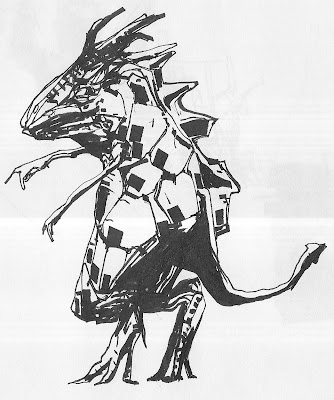 ...is about 4 inches tall and will demand strong drink or the answer to a riddle. Failure to provide one or the other will cause some small part of the interlocutor's body to burst into flame.
More blatant firebloat: firesnake and firetoad. For every scary thing in D&D there is a snake version of that thing and, on a 4-6, a toad version of that thing. There is little I can do with the word, concept, or picture of "firesnake" or "firetoad" to make them not just what they are. Here's my best shot...
 Here we have the firesnakeball, a weapons goblins make by feeding firedrakes to snakes. The flaming wad is then pitched forward at PCs in a coiling, burning wad which smacks some unlucky joe and then separates and crawls all over them just before the goblins themselves roll up and fight. Because goblins think arrows are boring.
 The firetoad is also a goblin thing but it's more a sneaky weapon like a caltrop. They're like the size of poison arrow frogs and you step on them and then that sucks because their blood burns you.
In majestic contrast to all this fire_____ bullshit, the flail snail is a perfect and unimprovable monster.
 Also, I am so happy about how my flail snail picture came out that I am going to post it twice. In the "what-it-looks-like-printed-after-you-photograph-it" version above and in the "what-it-looks-like-if-you-turn-the-contrast-down-so-you-can-see-all-the-little-pen-lines" version.
 This makes me think about the whole your-best-art-is-the-art-that's-about-the-things-you-care-about-most axiom. Hey, maybe. Second thing: OTHERWORLD! I am still willing to trade belladonna's home phone number for a flail snail mini. Get in touch, ok?
So anyway fuck the Flind. Way ahead of even "booka" and "bunyip" in competition for most malphonic word in the folio. Sounds like you're vomiting with a lisp. Flind. And so bloaty: a gnoll, only a little bigger and with a chainy weapon that would reappear in Oriental Adventures. So, the makeover: they are guignolls and they are alchemically-fucked up gnoll berserkers with prosthetic body parts. Exhibit A here has a chain with a guy's head on the end instead of an arm but each guignoll is unique. The rest of the gnolls treat these guys as sacred gladiators. Now people love to hate the flumph...
 ...but whatever, stupid beats boring any day, the raw material here is nowhere near as hopeless as the flind or the firesnake. Just turn it sideways...
 ...and, bam, perfectly serviceable* monster. Yeah, the name needs work..."Orth". Ok.
The Forlarren is unusual in being a tragic monster with a fairly compelling behavioral schtick: it longs to kill the PC and then feels just terrible about it once it succeeds. It has a kind of generic (but stylishly realized) Russ Nicholson bad-Puck picture, which can be fixed up by taking the redundant satyr-derived design elements out of it...
 ..and it has the rather unfairytalish power to heat metal up. Lets just say it'll make water boil. Including any water the PCs may be carrying. Or a whole lake, maybe.
At the end of "F" we got the frost man. Which is an eyepatchy kind of guy who can shoot a cone of frost from said patched void and who, in common with most cave-dwelling species, has extraordinarily poor taste in clothing. Anyway, I believe a writer far better than whoever invented the frost man (this guy?) could probably write a creepy short story where an entire race of men who all have eyepatches (but why do they...oh never mind...) and who shoot cones of frost from these desolate sockets and do creepy icy things or at least do a few things that don't just remind you of pirates and frosty cones and a million other things you'd rather think about than dumb eyepatch cavemen. I am not, tonight, that man. Today I am the man that drew a picture while trying to draw something else entirely of this guy...
 ...who I imagine is blue-skinned with white facial hair and who is 9 feet tall and who has a freezy touch and who stands waist-deep in arctic pools, demanding weird tolls from lone travellers.
______
*Yes I see your pun and have chosen to ignore it.
Up to "F"...
The original firdrake is pure monsterbloat. A little red dragon for a game that has baby red dragons and fire lizards already. So making it any kind of lizard is off the table. And taking the "drake" part literally and making it a kind of kind of duck is better left to DMs gonzo-er than I. I figure "firedrake" is a decent Vancian name for a mysterious fiery entity. The spark crawled and spun, pooling and pulling shapes from itself until it wore the familiar grin and curled talon of a firedrake...
So: if you cast a fireball and roll all 1's for damage, it becomes a firedrake, which is a mischievous sort of fire elemental that attacks the nearest flammable thing then jumps to the next flammable thing and the next and the next for a half an hour before fading out of existence...
 The only nice bit in the original firedrake entry is that the breath weapon is made of the lizard's own boiling blood. I'm going to say goblins use tame firedrakes to acidify and weaponize the blood of small animals. More on that later.
Firenewts are exactly like lizardmen but they breath fire. Which is really a great trick since it makes both lizardmen and dragons less unique and fun. This firenewt...
 ...is about 4 inches tall and will demand strong drink or the answer to a riddle. Failure to provide one or the other will cause some small part of the interlocutor's body to burst into flame.
More blatant firebloat: firesnake and firetoad. For every scary thing in D&D there is a snake version of that thing and, on a 4-6, a toad version of that thing. There is little I can do with the word, concept, or picture of "firesnake" or "firetoad" to make them not just what they are. Here's my best shot...
 Here we have the firesnakeball, a weapons goblins make by feeding firedrakes to snakes. The flaming wad is then pitched forward at PCs in a coiling, burning wad which smacks some unlucky joe and then separates and crawls all over them just before the goblins themselves roll up and fight. Because goblins think arrows are boring.
 The firetoad is also a goblin thing but it's more a sneaky weapon like a caltrop. They're like the size of poison arrow frogs and you step on them and then that sucks because their blood burns you.
In majestic contrast to all this fire_____ bullshit, the flail snail is a perfect and unimprovable monster.
 Also, I am so happy about how my flail snail picture came out that I am going to post it twice. In the "what-it-looks-like-printed-after-you-photograph-it" version above and in the "what-it-looks-like-if-you-turn-the-contrast-down-so-you-can-see-all-the-little-pen-lines" version.
 This makes me think about the whole your-best-art-is-the-art-that's-about-the-things-you-care-about-most axiom. Hey, maybe. Second thing: OTHERWORLD! I am still willing to trade belladonna's home phone number for a flail snail mini. Get in touch, ok?
So anyway fuck the Flind. Way ahead of even "booka" and "bunyip" in competition for most malphonic word in the folio. Sounds like you're vomiting with a lisp. Flind. And so bloaty: a gnoll, only a little bigger and with a chainy weapon that would reappear in Oriental Adventures. So, the makeover: they are guignolls and they are alchemically-fucked up gnoll berserkers with prosthetic body parts. Exhibit A here has a chain with a guy's head on the end instead of an arm but each guignoll is unique. The rest of the gnolls treat these guys as sacred gladiators.
 Now people love to hate the flumph...
 ...but whatever, stupid beats boring any day, the raw material here is nowhere near as hopeless as the flind or the firesnake. Just turn it sideways...
 ...and, bam, perfectly serviceable* monster. Yeah, the name needs work..."Orth". Ok.
The Forlarren is unusual in being a tragic monster with a fairly compelling behavioral schtick: it longs to kill the PC and then feels just terrible about it once it succeeds. It has a kind of generic (but stylishly realized) Russ Nicholson bad-Puck picture, which can be fixed up by taking the redundant satyr-derived design elements out of it...
 ..and it has the rather unfairytalish power to heat metal up. Lets just say it'll make water boil. Including any water the PCs may be carrying. Or a whole lake, maybe.
At the end of "F" we got the frost man. Which is an eyepatchy kind of guy who can shoot a cone of frost from said patched void and who, in common with most cave-dwelling species, has extraordinarily poor taste in clothing. Anyway, I believe a writer far better than whoever invented the frost man (this guy?) could probably write a creepy short story where an entire race of men who all have eyepatches (but why do they...oh never mind...) and who shoot cones of frost from these desolate sockets and do creepy icy things or at least do a few things that don't just remind you of pirates and frosty cones and a million other things you'd rather think about than dumb eyepatch cavemen. I am not, tonight, that man. Today I am the man that drew a picture while trying to draw something else entirely of this guy...
 ...who I imagine is blue-skinned with white facial hair and who is 9 feet tall and who has a freezy touch and who stands waist-deep in arctic pools, demanding weird tolls from lone travellers.
______
*Yes I see your pun and have chosen to ignore it.
Saturday, May 7, 2011
Here's A Tip
Busy with things, no time to post.
Do yourself a favor and spend half an hour checking out Bat In The Attic's blog. Consistently thoughtful stuff by a man who clearly types very fast.
Do yourself a favor and spend half an hour checking out Bat In The Attic's blog. Consistently thoughtful stuff by a man who clearly types very fast.
